


Choosing from the different pool shapes requires careful consideration of several important criteria. The rectangular shape remains a classic, appreciated for competitive swimming and its timeless style. Rounded or free-form models create a more natural ambiance, while the L-shaped version allows for separating swimming areas. The size of your plot, your budget, and the intended use are key points to consider before making your choice. A well-designed pool will add value to your property while meeting your relaxation and leisure needs.
What are the different pool shapes adapted to your space and needs?
There are many varied pool shapes, each meeting specific needs. The most common are rectangular, square, oval, round, free-form, L-shaped, and lagoon or shell-shaped pools. The rectangular shape is perfect for regular swimmers, offering a length suitable for athletic practice. Approximately 60% of homeowners choose this classic shape for its versatility. L-shaped pools, on the other hand, effectively separate the swimming area and the relaxation zone, ideal for families with multiple uses.
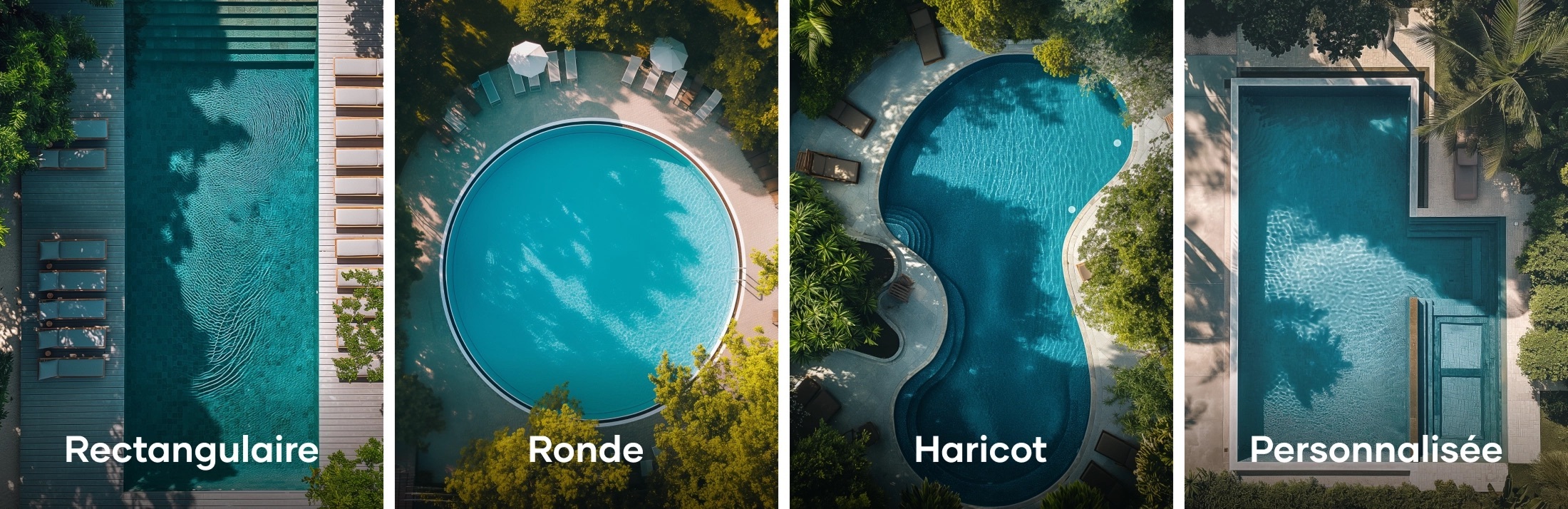
The choice of your pool shape must primarily consider the available surface area in your garden. For small spaces, geometric shapes like rectangles or squares optimize land use. Conversely, if you have a large garden, you can opt for more original shapes like free-form or shell-shaped pools that create an aesthetic focal point. It is also essential to consider your plot's configuration: sloping plots may require specific shapes adapted to semi-inground structures.
The intended use of your pool also influences the choice of its shape. For sports use, prefer elongated shapes like rectangles that promote lap swimming. If you are looking for a relaxation and play area, rounded or organic shapes are more suitable. They create a relaxed atmosphere and blend harmoniously into a landscaped garden. Rounded corners are also recommended for safety, especially if you have children.
The choice of the pool shape can also influence various parameters in the maintenance and cleaning of your pool. For cleaning, for example, in the case of a free-form choice, we advise you to opt for an adequate robot that adapts to all pool shapes, such as the Scuba S1 Pro from the brand Aiper, for example.
For pool filtration or water treatment, in the case of a complex-shaped pool, calculating the volume of your pool in m3 can be tedious, and therefore the choice of equipment can be influenced by an incorrect calculation. To simplify things for you, you can find our advice for calculating the volume according to the pool shape with precise adapted formulas.
Which pool shapes should be prioritized depending on the outdoor landscaping plan?
The harmonious integration of your pool into your garden largely depends on its environment. For a contemporary outdoor layout with clean lines, geometric shapes like rectangles or squares fit perfectly. These shapes adapt well to straight terraces and French-style gardens. Conversely, in a garden with a more natural or Mediterranean feel, organic or free shapes create visual continuity with the surrounding landscape. Nearly 40% of owners of landscaped gardens opt for these softer shapes that evoke a natural pond.
The relationship between your house and your pool is also crucial. A contemporary villa will elegantly associate with a pool with clean shapes, while a character house can accommodate a pool with more classic or organic lines. The orientation of your land also plays a crucial role: position your pool to maximize sun exposure throughout the day, while taking into account the shade cast by surrounding buildings or trees.
To create a coherent space, also think about the elements that will surround your pool. Terraces, decks, garden furniture, and plantings must form a harmonious whole with the shape of your pool. A round or oval pool can be enhanced by a circular terrace, while a rectangular pool will perfectly match a linear deck.
What are the different pool shapes depending on the construction materials?
The choice of construction material directly influences the possible pool shapes. Reinforced concrete offers complete freedom in design, allowing for the creation of custom, complex, or original shapes. This is the ideal solution if you are looking for a pool perfectly adapted to your space or your specific desires. However, these custom pools can cost up to 30% more than standard models, due to the artisanal work required for their construction.
Polyester shell pools offer predefined but varied shapes. You will mainly find rectangular, oval, or kidney-shaped models, with sometimes variants such as L-shapes or figure-eights. The advantage of these pools is their quick installation, usually in less than a week, and their often more accessible cost than concrete. However, the transport of the shell can limit the maximum dimensions, generally around 10 meters in length for the largest models.
Kit pools, whether made of steel panels, polymer, or wood, essentially offer simple geometric shapes such as rectangles, squares, or octagons. These modular structures are designed for easy assembly, which limits customization possibilities. Here is a comparative table of the possibilities offered by each material:
| Material | Possible Shapes | Advantages | Disadvantages |
|---|---|---|---|
| Reinforced Concrete | All custom shapes | Total customization, durability | High cost, long construction time |
| Polyester Shell | Varied predefined shapes | Quick installation, intermediate price | Limited choice to available models |
| Kit (steel, polymer) | Simple geometric shapes | Economical, DIY installation possible | Limited customization, shorter lifespan |
| Wood | Rectangular, square, octagonal | Natural aesthetic, ecological | Regular maintenance required, limited shapes |
How to choose the shape of your pool based on your aesthetic preferences?
The visual aspect of your pool is a key element of your long-term satisfaction. Aesthetic preferences vary considerably from person to person, and fortunately, the diversity of available shapes allows for meeting all tastes. For a contemporary and minimalist style, the straight lines of rectangular or square pools create an impression of clean elegance. These geometric shapes integrate perfectly into modern gardens and create a striking contrast with the surrounding plantings.
If you prefer a more natural and organic ambiance, turn to free or curved shapes. These pools evoke natural ponds and create a relaxed atmosphere, as if the pool had always been part of the landscape. Kidney shapes, popularized in the 1950s, are experiencing a resurgence of interest for their both vintage and timeless character. They naturally offer a shallow area in the concave part, ideal for installing steps or a submerged beach.
The decorative elements that accompany your pool also contribute to its overall aesthetic. The choice of the interior liner significantly influences the appearance of the water: a light blue liner will give a turquoise water, while a gray or black liner will create a more contemporary mirror effect. Coping, lighting, and landscaping are all elements that will enhance the chosen shape. Do not hesitate to draw inspiration from current trends while keeping in mind that your pool is a long-term investment that should please you for many years.
- For a Mediterranean style: opt for free or lagoon shapes with rocks and waterfalls
- For a contemporary style: prefer straight, rectangular or square lines
- For a classic style: choose a rectangular shape with rounded corners or an oval shape

Conclusion
Choosing from the different available pool shapes requires taking into account many factors: the size of your garden, your usage needs, your budget, your aesthetic preferences, and the technical constraints related to your land. Geometric shapes like rectangles and squares offer versatility and ease of integration, while free or organic shapes bring a touch of originality and a more natural aspect to your outdoor space.
Remember that the chosen shape will have an impact on ease of maintenance and the possibility of installing certain equipment such as automatic covers or enclosures. Simple shapes generally facilitate the installation of these devices, but current technologies increasingly allow these equipments to be adapted to more complex shapes. Also think about the evolution of your needs over time: a family with young children will not have the same expectations as a family with teenagers or adults.
To make the best choice, take the time to visit showrooms, consult catalogs, and discuss with professionals. They can guide you towards the shape that best suits your expectations while respecting your constraints. Whatever shape you choose, the essential thing is that it brings you pleasure and integrates harmoniously into your outdoor living space to create a place of relaxation and conviviality that you will enjoy for many years.
FAQ
What are the different types of pools?
The different types of pools include concrete, polyester, steel, and especially above-ground pools. Each has its distinct characteristics in terms of price, maintenance, and durability, making it possible to find one that best suits everyone's needs and budget.
What is the cheapest pool shape to build?
The cheapest pool shape to build is generally the rectangular pool. This shape allows for efficient use of materials and simplified design, which reduces construction and installation costs while offering optimal functionality for swimming.
What is the best pool shape?
The best pool shape depends on the desired uses. The rectangular pool is ideal for swimming, while free forms offer an attractive aesthetic. Choosing a shape adapted to the space and environment is essential to maximize the swimming experience.
What type of pool requires the least maintenance?
The type of pool that requires the least maintenance is generally the polyester shell pool. Its smooth surface reduces the accumulation of dirt, which decreases the frequency of cleaning and the use of chemicals, making maintenance simpler and less costly.
What pool shape is the most user-friendly?
The most user-friendly pool shape is often the round pool. This shape promotes an intimate and social atmosphere, allowing users to gather easily and enjoy optimal conviviality, ideal for families and groups of friends.



































