


The choice of swimming pool liner is an important step to ensure the watertightness and durability of your pool. This PVC membrane must be carefully selected based on several criteria such as thickness, material quality, UV resistance, and fixing method. To make the right choice, you must also consider the shape of your pool, its use, and your budget. A liner adapted to your specific needs will guarantee a watertight and beautiful pool for many years, while minimizing maintenance costs.
What questions should you ask to make the right choice of swimming pool liner?
Choosing the right liner for your pool is essential to guarantee the watertightness and beauty of your pool for many years. To make the ideal swimming pool liner choice, you must first consider the size and shape of your pool. A custom-made liner ensures a perfect fit to the structure and optimal watertightness. Then, think about how your pool will be used: will it be used intensively or occasionally? This answer will influence the necessary thickness.
Also ask yourself questions about your pool's environment. Is it very exposed to the sun? In this case, a liner with UV protection will be preferable. The color and finish are also important for aesthetics but also for the water temperature. Finally, consider your total budget including the material, installation, and future maintenance. The choice of swimming pool liner must be a balance between durability, aesthetics, and cost.
What are the main criteria for choosing a swimming pool liner?
To successfully choose your swimming pool liner, several essential criteria must be taken into account. The first is the liner's thickness, which determines its resistance and longevity. The thicker the liner, the more it will resist tears and mechanical stress. For an inground pool, a thickness between 75/100ths and 90/100ths is generally recommended, while for an above-ground pool, 50/100ths may suffice.
The quality of the material is also crucial. A liner compliant with the French standard NF T54 803-1 guarantees a quality product that meets safety standards. UV resistance is another important factor, especially if your pool is located in a sunny region. A liner with an anti-UV protective layer will extend its lifespan by up to 30% in these conditions.
Finally, the fixing system must be adapted to your type of pool. There are different options such as the Hung, Overlap, or Unibead systems, each with its specificities. Compatibility with your existing structure is essential to avoid installation or sealing problems.
How to select the right liner thickness for your pool?
The liner's thickness is a determining criterion that directly influences its durability. For an inground pool, it is recommended to choose a liner between 75/100ths and 90/100ths thick. This range offers a good balance between resistance and flexibility, allowing for easy installation while ensuring good protection. For highly used pools or those equipped with heavy accessories such as robot cleaners, a reinforced or reinforced liner of 150/100ths will be more suitable.
For above-ground pools, a standard liner of 50/100ths to 75/100ths is generally sufficient. However, if your pool is frequently used by children or if you have pets, opt for a thicker liner to prevent perforations. The lifespan of a liner directly depends on its thickness: a well-maintained 75/100ths model can last between 8 and 15 years, whereas a thinner liner will need to be replaced more quickly.
Your pool's environment must also be taken into account. If your pool is exposed to extreme temperatures or difficult climatic conditions, opt for a thicker liner that will better resist these constraints.
Which liner finish and color match your aesthetic expectations and your pool's use?
The finish and color of the liner are not only aesthetic choices; they also have an impact on the use and maintenance of your pool. A liner with varnish or an anti-UV protective layer is particularly recommended in sunny regions, extending its lifespan and preserving the brilliance of its color. For a pool very exposed to the sun, this type of protection is almost indispensable.
Regarding color, each shade creates a different atmosphere and influences the appearance of the water:
- Light blue or white: bright and clear water, ideal for a traditional pool effect
- Sand or light gray: natural effect, reminiscent of a beach or lake
- Black or anthracite: increases the impression of depth, elegant mirror effect
- Green or patterns: integrates harmoniously into a vegetal environment
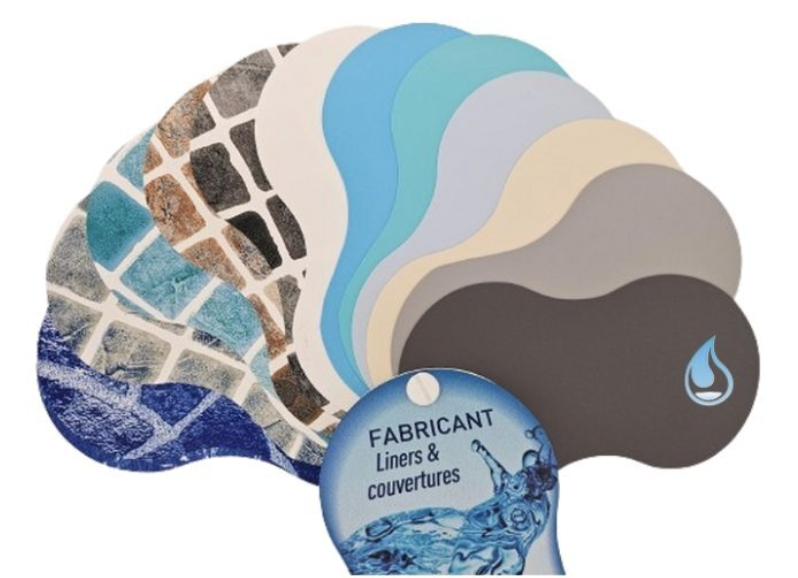
Note that a light-colored liner shows dirt more easily and therefore requires more maintenance, while a dark-colored liner can fade more quickly under the effect of the sun. If your pool is mainly used for relaxation, you can prioritize aesthetics. For sports use, colors offering good visibility of the bottom, such as blue, are preferable for safety.
What are the different liner fixing options and how to choose them well?
The fixing system for your liner must be chosen according to the type of pool you own. There are several options, each with its specific advantages. The Hung system (or hooked) is the most commonly used for inground pools. This system ensures a high-end aesthetic finish and excellent watertightness thanks to a hanging profile fixed to the wall.
For above-ground pools, the Overlap system is often preferred. Simple to install, it consists of folding the liner over the edge of the structure and holding it in place with profiles. Economical and accessible to DIY enthusiasts, this system is perfectly suited for standard pools. The Unibead system is more versatile, allowing installation in either Hung or Overlap mode, thus offering more flexibility.
| Fixing System | Advantages | Disadvantages |
|---|---|---|
| Hung (hooked) | Aesthetic finish, optimal watertightness | More complex installation, higher cost |
| Overlap | Easy installation, economical | Less aesthetic, risk of folds |
| Unibead/J-Hook | Versatile, adaptable | Intermediate price |
| Sheet metal | Enhanced stability | Only compatible with certain supports |
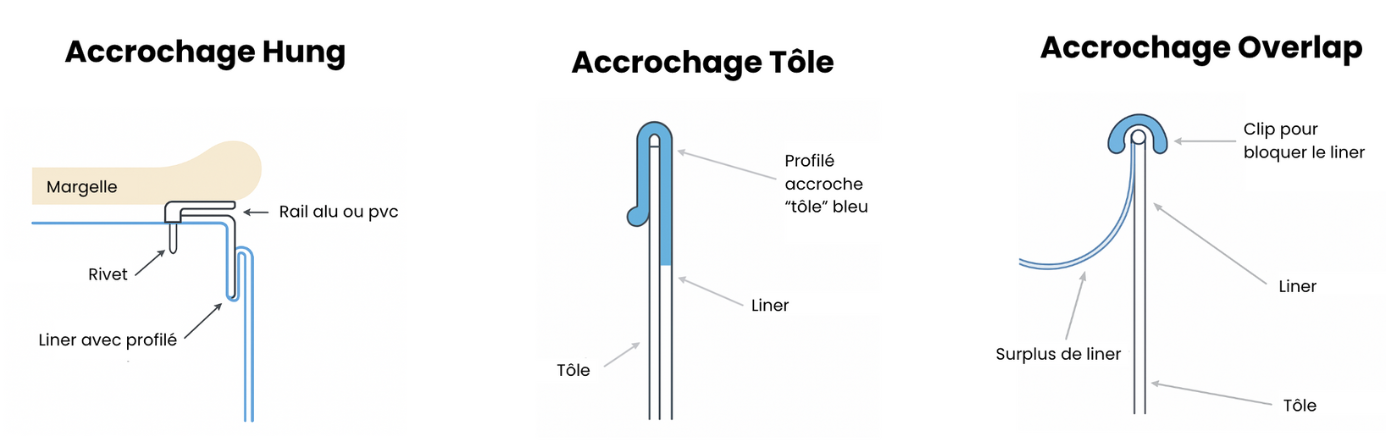
The choice of fixing system must take into account not only your type of pool, but also your DIY skills if you plan to install it yourself. For a durable and trouble-free installation, the Hung system remains the reference, especially for inground pools.
What do you need to know about the price and installation of the liner?
The price of a liner varies considerably depending on several factors. For an above-ground pool, count between 100 and 1,000 euros depending on the model and quality. For an inground pool, a custom-made liner generally costs between 12 and 30 euros per square meter for a standard model, and can reach 150 euros/m² for reinforced liners or those with special finishes. To this material cost is added the installation cost if you use a professional, generally between 500 and 1,500 euros depending on the complexity of the pool.
Installing a liner requires specific tools and meticulous preparation of the pool. Here are the essential elements for a successful installation:
- Rails and hanging angles adapted to the chosen fixing system
- Felt or protective foam for the bottom and walls
- Prior fungicidal treatment to prevent the development of mold
- Blocking rods to ensure the watertightness of sensitive areas
Although professional installation represents an additional cost, it guarantees perfect installation, an essential condition for the durability of your liner. For a simple above-ground pool, self-installation remains feasible with good instructions and a little patience.
Conclusion: optimizing the choice of liner for a durable and aesthetic pool
To optimize the choice of swimming pool liner, it is essential to consider all the criteria we have discussed. The thickness must be adapted to the use of your pool: opt for a thicker liner (minimum 75/100ths) for an inground or heavily used pool, and a standard liner for an above-ground pool with moderate use. The finish with anti-UV protection is a wise investment that will significantly extend the life of your liner, especially in sunny regions.
The color and pattern must correspond not only to your aesthetic tastes, but also to the conditions of use and maintenance that you are willing to assume. The fixing system must be chosen according to your type of pool and your installation skills. Finally, do not underestimate the importance of careful installation, whether done by yourself or by a professional.
Choosing the right liner is not just a matter of aesthetics; it is first and foremost a technical choice that will influence the durability of your pool. By investing in a quality liner, adapted to your pool and correctly installed, you will enjoy a watertight and beautiful pool for many years. Do not hesitate to consult experts like our team to guide you in this important choice.
FAQ
What is the best liner for a pool?
The best liner for a pool depends on the specific needs of each user. Consider factors such as material quality, durability, aesthetics, and cost to make an informed choice.
What pool liner color ages best?
The pool liner color that ages best is often blue. This classic blue retains a beautiful appearance over time and blends well with the water, offering a pleasant aesthetic even as it ages.
What is the lifespan of a 75-100 liner?
The lifespan of a 75-100 liner generally varies between 10 and 15 years depending on its maintenance, sun exposure, and quality. Appropriate use and treatment can extend its longevity.
What color is the water with a gray liner?
The water color with a gray liner tends to be light blue to grayish. This color creates an elegant atmosphere and can give the impression of warmer water.
What types of pool liners are available?
The types of pool liners available include PVC, vinyl, and algumat. Each of these materials offers varying resistance, budget, and aesthetic characteristics to meet user needs.
How to choose the right liner for a pool?
Choosing the right liner for a pool involves considering the dimensions, pool shape, budget, and desired lifespan. A thoughtful choice ensures a suitable and durable liner for your installation.



































