


Spring is approaching and the good weather is on the horizon. For pool owners, it's the ideal time to think about reactivating the filtration system. This crucial step prepares the pool for the summer season and ensures clean, healthy water. Let's look at when and how to restart your pool's filtration to fully enjoy the upcoming swims.
Reactivating the pool's filtration system is crucial to prepare for the summer season:
- Optimal Timing: restart when daytime temperatures reach 15°C
- Key Steps: pool cleaning, filter check, water level control
- Continuous Monitoring: adjust filtration duration according to water temperature
- Regular Maintenance: clean pre-filter, monitor pressure, check seals
The Ideal Time to Restart Filtration
Choosing the right moment to restart the pool filtration depends on several factors. The outside temperature plays a decisive role in this decision. Generally, it is recommended to reactivate the system when daytime temperatures stabilize around 15°C.
Here are some guidelines to help you choose the right time:
- Early March to early April: southern regions of France
- Mid-April to early May: central and northern regions
- Early May: mountainous regions or areas with cooler climates
It should be noted that these periods may vary depending on the weather conditions specific to each year. Carefully observe the forecasts and the evolution of temperatures in your region to adapt your restart schedule.
The early reactivation of the filtration system offers several advantages. It helps prevent the proliferation of algae and bacteria that may have developed during winter. In addition, an early start facilitates cleaning and balancing the water, allowing you to enjoy your pool more quickly from the first warm days.
Steps to Efficiently Restart Filtration
Restarting your pool's filtration requires a methodical approach. Here are the steps to follow to reactivate your filtration system with peace of mind:
- Carefully clean the pool and its surroundings
- Check the condition of the pool filter and clean it if necessary
- Check water levels and adjust if necessary
- Inspect pipes and connections for any leaks
- Prime the basin pump by filling it with water
- Start the filtration system gradually
- Monitor operation during the first few hours
Once these steps are completed, it is crucial to maintain regular monitoring of the system during the first few days. This will allow you to quickly detect any potential problems and intervene if necessary.
Don't forget to check and adjust water parameters (pH, chlorine, alkalinity) after restarting. A correct balance of these elements is essential to ensure healthy and pleasant water throughout the season.
Optimizing Filtration Operation
To get the most out of your filtration system and maintain quality water, it is important to adapt its operation to the climatic conditions and the use of the pool. Here is a summary table of recommended filtration durations based on water temperature:
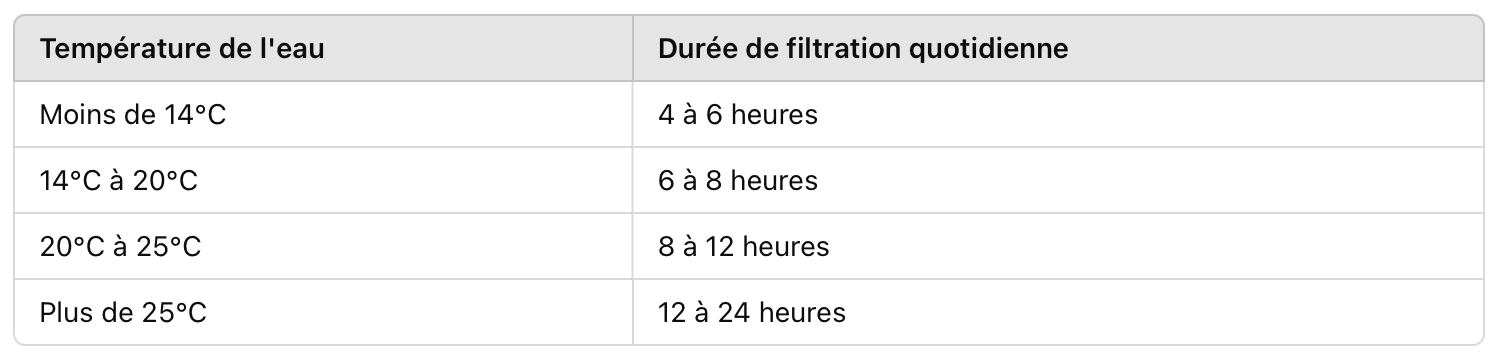
It is better to split the filtration time into several time slots rather than running the system continuously. This approach optimizes filtration efficiency while saving energy.
Also remember to adjust the filtration duration based on pool use. Days of high traffic or intense heat will require longer filtration to maintain water quality.
Regular Maintenance for Efficient Filtration
Once filtration is restarted, it is essential to maintain regular maintenance to ensure its effectiveness throughout the season. Here are some tips to preserve your system's performance:
Regularly clean the pump pre-filter to prevent the accumulation of debris that could hinder the proper functioning of the system. This simple but crucial operation should be performed at least once a week, or more frequently in case of heavy pool use or unfavorable weather conditions.
Monitor the filter pressure and backwash as soon as necessary. This operation removes impurities accumulated in the filter media and restores filtration efficiency. Generally, backwashing is recommended when the pressure increases by 30% compared to the normal value.
Don't forget to regularly check the condition of the seals and fittings to prevent leaks that could compromise the system's effectiveness. Promptly replace any worn or damaged elements to avoid more significant problems.
Finally, consider having your installation checked by a professional at least once a year, ideally before restarting filtration. This inspection will help detect and resolve any potential problems before they become more serious, thus ensuring a serene and pleasant swimming season.



































