


Good filtration is essential for keeping pool water clean and healthy. Your filter pump plays a crucial role by circulating the water to remove impurities, debris, and microorganisms. The ideal operating time depends on several factors such as water temperature, frequency of use, and the season. We will explain how to calculate the optimal filtration time and program your system to get the best results while controlling your energy consumption.
Understanding the Importance of Filtration Time
Factors Influencing Filtration Duration
Did you know that filtration accounts for 80% of your pool water quality? It's true! Chemicals only complement this essential work. Good filtration is therefore the basis of clean and healthy water. Several factors will determine how long your filter pump needs to run each day.
These factors include your pool's size, the season of the year, and, of course, the number of people swimming. The more swimmers there are, the harder your filtration system will have to work to keep the water clean. Filtration is like your pool's heart—it circulates the water to remove impurities.
Why Water Temperature is Crucial
Water temperature is the most important factor in determining the necessary filtration duration. Why? Because bacteria and algae grow much faster in warm water. When your pool water reaches 28°C or higher, these microorganisms can multiply rapidly.
The warmer the water, the longer you will need to filter. This is a simple but essential rule for keeping your pool clean and preventing the water from turning green or cloudy. The filter pump therefore plays a crucial role during warm periods.

Calculating Filtration Duration
How to Divide Water Temperature
There is a simple and effective method to calculate the ideal filtration time: divide the water temperature by two. This formula gives you the recommended number of filtration hours per day. For example:
- If the water is at 20°C, filter for 10 hours (20 ÷ 2 = 10)
- If the water is at 24°C, filter for 12 hours (24 ÷ 2 = 12)
- If the water is at 26°C, filter for 13 hours (26 ÷ 2 = 13)
This simple method allows you to precisely adapt your filter pump's operating time to your pool's actual conditions. Remember to regularly measure the water temperature, as it can vary quickly depending on the weather.
Filtration Time Based on the Number of Swimmers
The number of people using your pool directly impacts water quality. The more swimmers there are, the longer you will need to filter. Here is a table to help you adjust your filtration time based on usage:
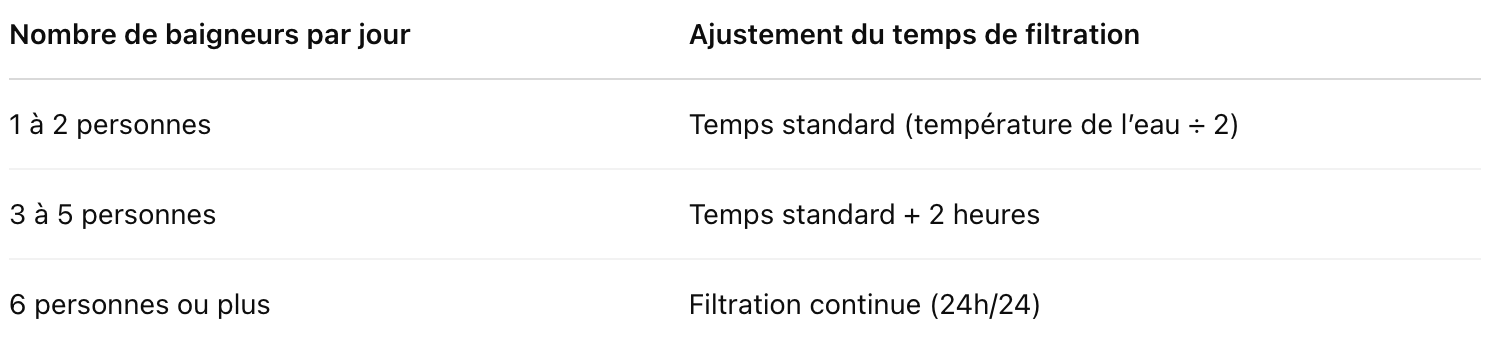
During a pool party or a weekend with many guests, do not hesitate to run your filter pump continuously. This will help keep the water clean despite intensive use.
When to Activate the Filter Pump
Recommended Filtration Times
The choice of filtration times should not be taken lightly. The hottest hours of the day (between 11 am and 4 pm) are particularly important for filtration. This is when bacteria and algae grow fastest.
It is generally more effective to divide the total filtration time into 2 or 3 cycles per day, rather than running the pump for a single long period. For example, for 12 hours of filtration, you could program:
- A first cycle from 6 am to 10 am (4 hours)
- A second cycle from 12 pm to 4 pm (4 hours)
- A third cycle from 6 pm to 10 pm (4 hours)
This distribution ensures clean water throughout the day, while maximizing your filtration system's efficiency.
Seasonal Usage and Impact on Filtration
Your pool does not have the same needs throughout the year. During peak summer season, when the pool is heavily used and temperatures are high, filtration should be longer. However, in spring and autumn, you can gradually reduce the filtration time.
During winter, if you don't winterize your pool, 2 to 3 hours of filtration per day may suffice when the water temperature is below 12°C. Remember to adjust your filter pump's programming according to the seasons to optimize its use.
Optimizing Filter Pump Usage
Saving Energy While Maintaining Cleanliness
The filter pump is one of the most energy-intensive pieces of equipment in your pool. To reduce your electricity consumption, several solutions exist. If you have a subscription with peak/off-peak tariffs, you can schedule part of your filtration during off-peak hours to save money.
However, avoid filtering only at night, as it is during the day that the sun promotes algae growth. The ideal is to distribute filtration between day and night. At PoolPlanet, we offer variable speed pumps that allow you to adapt filtration power to actual needs, thereby reducing energy consumption by up to 80%.

Alternatives for Efficient Filtration Operation
To optimize your filtration system's efficiency, several short cycles are often preferable to a single long cycle. This method helps maintain water quality while limiting electricity consumption.
Smart filter pumps, like those offered by our partner Pentair, can also be programmed to automatically adapt to water temperature and usage conditions. These modern devices simplify your life while ensuring optimal filtration. Thanks to applications like Vigipool, you can even control your filtration remotely from your smartphone.
Filter Pump Maintenance
Preparing the Pump for Winterization
When temperatures start to drop and the water falls below 12°C, it's time to adapt your filtration system's operation. During winter, reduce filtration time to about 2 hours a day, ideally in the middle of the day when temperatures are mildest.
If you live in an area where temperatures can drop below 0°C, consider protecting your filter pump from freezing. You can install a frost protection box that will automatically stop filtration if there is a risk of freezing. Some owners prefer to completely drain the water circuit and pump to avoid any damage during the winter months.

Regular Diagnosis and Maintenance
To ensure efficient filtration, regular maintenance of your filter pump is essential. Regularly check the pump's pre-filter and clean it if necessary. Baskets full of debris significantly reduce filtration efficiency.
Also, monitor the pressure indicated on the filter pressure gauge. Too high a pressure indicates it's time to clean or backwash your filter. A well-maintained filter pump will last longer and filter more efficiently, allowing you to enjoy crystal clear water while limiting your energy consumption.
Conclusion on Filtration Duration
Summary and Practical Recommendations
To recap, the ideal filtration duration for your pool primarily depends on the water temperature. The basic rule is to divide this temperature by two to get the number of filtration hours needed per day. Remember to increase this time in case of heavy use or a heatwave.
Prefer filtration divided into several cycles throughout the day, including the hottest hours. Adapt your filtration program according to the seasons, and do not hesitate to invest in a variable speed filter pump to achieve significant energy savings.
Importance of Adjustment Based on Specific Needs
Each pool is unique and may require specific adjustments. Regularly observe your water's condition to determine if your filtration time is sufficient. Cloudy water or early signs of algae generally indicate that filtration needs to be increased.
Do not hesitate to consult our PoolPlanet team for personalized advice on your pool's filtration. With the right settings and regular maintenance, your filter pump will guarantee crystal clear water throughout the swimming season, while optimizing your energy consumption. A well-filtered pool is the secret to a pleasant and worry-free swim!
FAQ
Should the pool be filtered every day?
Generally, it is recommended to filter your pool every day to ensure clean and clear water. However, this depends on several factors such as water temperature, frequency of use, and climatic conditions.
What is the filtration time chart for a pool?
The filtration chart depends on the number of swimmers and the water temperature. For 1-2 people, filter for the standard time (temperature ÷ 2), for 3-5 people, add 2 hours, and for 6 or more people, run the filtration continuously.
When should pool filtration be stopped?
You can stop filtration when the water temperature drops below 12°C in winter or if the pool is not used for an extended period. Be sure to clean the pump and protect it from freezing if necessary.
Is it possible to leave the pool pump running continuously?
Yes, it is possible to leave the pump running continuously, but it is not always cost-effective. Continuous filtration could lead to high energy costs and is generally only necessary during heavy use.
What are the advantages of a variable speed filter pump?
A variable speed filter pump allows you to adjust the power according to needs, thereby reducing energy consumption by up to 80%. It also extends the lifespan of the equipment by preventing excessive wear.
How to effectively clean a filter pump?
For effective cleaning, it is crucial to regularly check the pre-filter, disassemble it, and rinse it. It is also advisable to check the pressure gauge; too high a pressure indicates that cleaning or backwashing is necessary.
What are the consequences of insufficient filtration?
Insufficient filtration can lead to cloudy water, the development of algae and bacteria, making swimming unpleasant or even risky for health. Hence the importance of correctly adjusting the filtration time according to use and season.



































