


Are you wondering how long your pool's filter sand lasts? The typical lifespan is 4 to 5 years, but it can vary depending on several factors such as product quality, frequency of use, and maintenance. Good quality, calibrated silica sand, regular cleaning, and optimal chemical balance of the water can extend its service life to 7 to 8 years. To prolong its lifespan, perform weekly backwashes and monitor the filter pressure. A partial replacement every 2-3 years also helps maintain efficient filtration.
How long does filter sand last depending on use and maintenance?
Pool filter sand generally has a lifespan of 4 to 5 years. However, this duration can vary significantly depending on several factors. With optimal maintenance and good quality sand, some filters can operate effectively for 10 to 15 years! The frequency of your pool's use, water quality, and especially the regular maintenance you perform play a decisive role in its longevity. Experts generally recommend a partial sand replacement every 2 to 3 years to maintain effective filtration. This top-up helps compensate for the natural degradation of the filter media without having to replace it entirely.
What factors influence the longevity of filter sand?
Regular maintenance and backwashing
Regular maintenance is the most crucial factor for the lifespan of your filter sand. Backwashes should be performed as soon as the filter pressure increases by 0.5 bar above its normal value. These cleanings remove accumulated impurities that can form preferential channels in the sand and reduce its effectiveness. A vigilant owner who performs regular backwashes can easily double the lifespan of their filter media. Conversely, neglecting this step accelerates the accumulation of calcium and limescale, which are the main causes of sand deterioration.
Initial sand quality and replacement frequency
Choosing quality sand from the start greatly influences its durability. A calibrated and washed special pool sand will withstand time better than ordinary sand. The recommended particle size (generally between 0.4 and 0.8 mm) ensures optimal filtration while limiting wear. Some manufacturers recommend partially replacing the sand every 2 to 3 years, replacing about 30% of its volume. This practice helps prevent the formation of hardened blocks and maintains filter efficiency without having to replace everything. The pool's usage rate and water quality (hardness, pH) are also factors that determine the ideal replacement frequency.
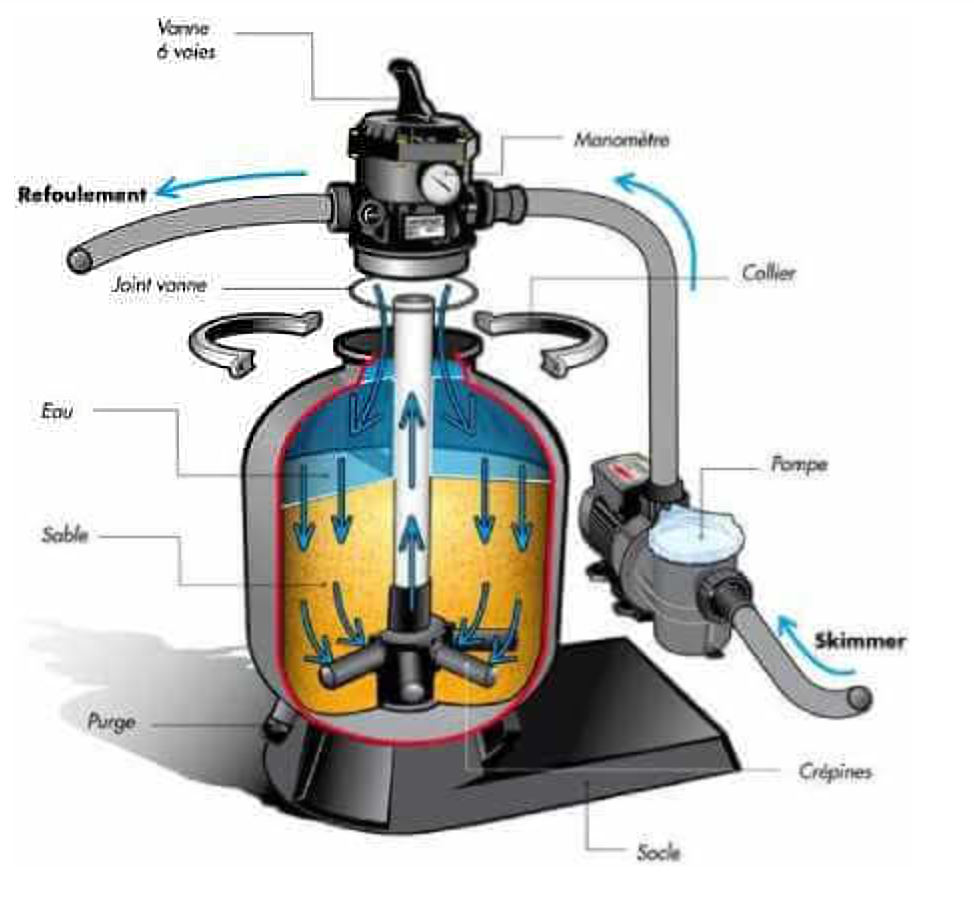
How to recognize when filter sand needs to be replaced?
Visible signs and pressure measurements
Several signs indicate that it's time to replace your filter sand. The first clue is water that remains cloudy despite adequate treatments and regular backwashes. If you also notice a constant increase in pressure on the manometer (the device that measures pressure in your filter), it's often a sign that the sand is clogged. Other signs may include:
- Presence of sand at the bottom of the pool
- Significant reduction in water flow
- Need for much more frequent backwashes
- Appearance of algae despite correct chemical treatment
If you observe several of these signs simultaneously, even before the theoretical 4-5 years, it's probably time to change your filter media.
Simple tests to assess sand quality
You can easily check the condition of your sand with a few simple tests. Start by taking a handful of sand from your filter (after stopping and partially draining it). Good quality sand should flow freely through your fingers. If it forms clumps or blocks, it's a sign that it's clogged with limescale or impurities. You can also place a sample in a transparent container filled with water: degraded sand will tend to form a cloudy haze or release colored particles. These tests allow you to visually assess whether your filter media still has good absorption capacity or if it has become ineffective over time.
What are the differences in durability between different types of filter media, including filter sand?
Not all filter media are equal in terms of durability. The table below compares the main options available on the market:
| Type of filter media | Average lifespan | Advantages | Disadvantages |
|---|---|---|---|
| Standard silica sand | 4-5 years | Economical, easy to find | Sensitive to limescale, average filtration |
| Filter glass | 7-10 years | Better filtration, resistant to limescale | More expensive, specific installation |
| Zeolite | 7-10 years | Excellent filtration, absorbs ammonium | High price, specific maintenance |
| Synthetic fibers | Approximately 5 years | Lightweight, large filtration surface | Less resistant, higher initial cost |
Filter glass has become a popular alternative to traditional filter sand, with a lifespan that can be double. Its structure does not degrade as easily, and it is more resistant to limescale. Zeolite also offers excellent long-term performance, but at a higher price. For standard family pools, sand remains the most common choice, offering a good balance between cost, performance, and ease of maintenance. About 75% of pool owners still use this traditional filter media despite the emergence of new alternatives.
Can the lifespan of filter sand be extended?
It is entirely possible to significantly extend the lifespan of your filter sand through a few appropriate maintenance practices. The first is to perform regular backwashes, ideally once a week during periods of intensive use and as soon as the filter pressure increases. The periodic use of specific descaling products for filters also helps remove limescale that gradually accumulates in the sand. These treatments can be applied 2 to 3 times per season.
To maximize the longevity of your filter media, also consider:
- Completely cleaning the filter once a year (opening and manual cleaning)
- Maintaining a chemical balance of the water to avoid excessive calcification
- Regularly monitoring the manometer pressure "How to quickly change the manometer of a sand filter"
Conclusion
The lifespan of filter sand generally ranges from 4 to 5 years, but can reach 10 to 15 years with optimal maintenance. The key factors determining this longevity are the frequency of backwashes, the initial quality of the sand, and the chemical balance of your pool water. To know when to replace your filter media, pay attention to signs such as cloudy water, increased pressure, or the presence of sand in your pool. Alternatives like filter glass or zeolite offer superior durability, but at a higher cost.
To get the most out of your filtration system, don't hesitate to invest in quality sand and follow a rigorous maintenance schedule. Partial replacement every 2-3 years can also extend the overall lifespan of your filter. Ultimately, properly maintaining your filter sand will allow you to enjoy crystal clear water while saving money in the long run.
FAQ
How do I know if the filter sand needs changing?
To know if the filter sand needs changing, observe the quality of the pool water. If the water is cloudy despite the filter working properly, it's possible that the sand is saturated or worn out, requiring replacement.
When should pool filter sand be changed?
It is recommended to change pool filter sand every 3 to 5 years, depending on use and maintenance. Regular inspection and adequate maintenance can extend its lifespan.
What is the lifespan of a pool sand filter?
The lifespan of a pool sand filter depends on its type and maintenance. In general, a sand filter can last between 5 and 15 years, but regular maintenance improves the system's longevity.
What is the best sand for a pool filter?
The best sand for a pool filter is silica sand or quartz sand. Its particle size should be between 0.4 and 0.8 mm, ideally selected to optimize filtration efficiency.
What is filter sand?
Filter sand is a filter media primarily used in pool filters to retain impurities. Its specific particle size, generally between 30 and 40 microns, allows for efficient particle filtration.



































